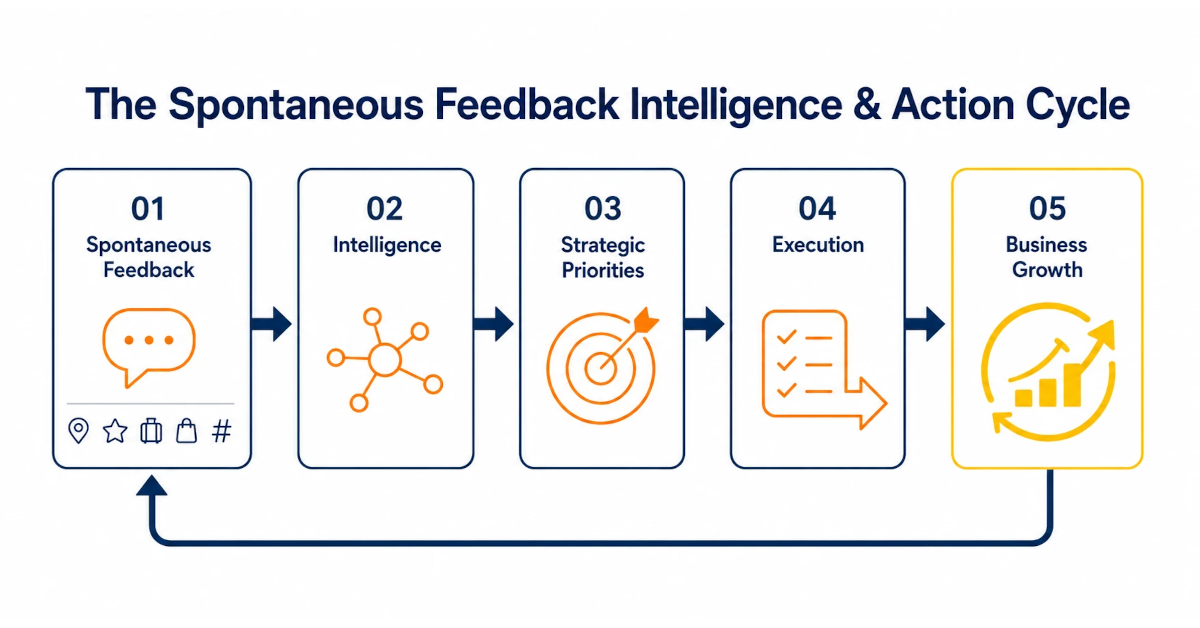
A PDCA-based framework links recurring customer problems to accountable actions, follow-up measurement and organizational learning.
BARUERI, SAO PAULO, BRAZIL, November 23, 2026 /EINPresswire.com/ — Yellow Tokens has published a framework for transforming recurring spontaneous customer feedback into structured continuous improvement cycles based on the Plan-Do-Check-Act (PDCA) methodology.
The framework addresses a recurring challenge in customer experience management: organizations can identify complaints, pain points and operational weaknesses without establishing a clear process for deciding what should be fixed, who should act and whether the intervention worked.
Yellow Tokens designed the approach to connect customer intelligence with operational accountability. Rather than ending with dashboards or reports, recurring feedback signals can become prioritized improvement initiatives with defined actions, responsible owners, collaborators, deadlines and follow-up measurement.
“Understanding what customers are saying is only the beginning,” said Bruno Pomeranz of Yellow Tokens. “Continuous improvement requires a second layer: deciding what to change, assigning responsibility, executing the change and then checking whether customers actually experience the difference.”
The Yellow Tokens framework applies the four PDCA stages, supported by an additional organizational learning layer.
Plan: Identify and prioritize recurring problems
The planning stage analyzes spontaneous public customer feedback to identify recurring complaints, internal weaknesses and potential root causes.
Instead of treating each negative comment as an isolated incident, the process examines recurring patterns that may indicate broader operational or customer experience problems.
These patterns become inputs for prioritizing improvement opportunities.
Do: Assign responsibility and execute actions
Once an improvement opportunity has been prioritized, teams can select suggested actions, adapt them to operational realities or create their own corrective measures.
Each initiative can have responsible owners, collaborators and defined deadlines, helping move the insight from analysis into accountable execution.
Check: Measure the customer response
After actions have been implemented, new spontaneous customer feedback can be analyzed to assess whether recurring complaints become less frequent, satisfaction indicators change or customers describe the affected experience differently.
This stage emphasizes an important distinction: completing an action does not necessarily mean that the underlying customer problem has been resolved.
Act: Adjust interventions or reinforce improvements
If the issue persists, organizations can revise the original intervention or consider more structural actions.
When subsequent feedback indicates improvement, successful practices can be reinforced and incorporated into ongoing operations.
Learn: Preserve organizational knowledge
Beyond the traditional PDCA cycle, Yellow Tokens incorporates an organizational learning layer.
Completed improvement cycles can preserve what was attempted, which actions were implemented and what subsequent feedback indicated.
This history helps teams make future decisions without repeatedly diagnosing the same problem or losing knowledge about previous interventions.
From customer complaints to operational decisions
A recurring complaint about service delays illustrates the framework.
Organizations can investigate potential causes, prioritize corrective actions, assign responsible teams and establish implementation deadlines.
After the intervention, newly published customer feedback provides additional evidence about whether the customer experience has changed.
If complaints continue, the organization can reconsider its approach rather than assuming that completing the planned tasks solved the problem.
The objective is to create a repeatable management process in which feedback remains relevant after an action plan has been executed.
Internal improvement and competitive opportunities
Yellow Tokens distinguishes Continuous Improvement PDCA Action Plans from its Competitor Gaps framework.
PDCA Action Plans address internal weaknesses identified through an organization’s own customer feedback.
Competitor Gaps Action Plans focus on external market opportunities associated with competitors’ recurring weaknesses, using comparative evidence to assess whether an organization has a credible advantage.
Together, the frameworks provide two different paths from customer intelligence to action: improving internal operations and acting on validated competitive opportunities.
The continuous improvement framework is part of Yellow Tokens’ broader Spontaneous Feedback Intelligence & Action (SFIA) approach.
SFIA connects voluntarily published customer feedback with structured intelligence, prioritization and execution.
Within this approach, continuous improvement closes the feedback loop by reconnecting executed actions with future customer signals.
The objective is not simply to collect more feedback, but to establish a cycle in which organizations listen, prioritize, act, measure and learn.
Additional information is available through the Yellow Tokens pages on Continuous Improvement PDCA Action Plans and Spontaneous Feedback Intelligence & Action.
ABOUT YELLOW TOKENS
Yellow Tokens is a software company focused on transforming spontaneous public customer feedback into structured intelligence, priorities and action. Its platform combines customer feedback analysis, artificial intelligence and structured execution frameworks to identify recurring problems, support competitive analysis and help organizations manage continuous improvement initiatives.
BRUNO POMERANZ
Yellow Tokens
support@yellowtokens.com
Visit us on social media:
LinkedIn
Instagram
Facebook
YouTube
TikTok
Legal Disclaimer:
EIN Presswire provides this news content “as is” without warranty of any kind. We do not accept any responsibility or liability
for the accuracy, content, images, videos, licenses, completeness, legality, or reliability of the information contained in this
article. If you have any complaints or copyright issues related to this article, kindly contact the author above.

Media gallery