WUXI, JIANGSU, CHINA, October 11, 2026 /EINPresswire.com/ — Heavy rotational machinery experiences intense mechanical stress during daily industrial operations. Equipment manufacturers build massive mining excavators, port cranes, and wind energy turbines to withstand extreme operational conditions. These high-capacity systems rely heavily on large-diameter slewing bearings and robust ring gear blanks to transfer enormous torsional loads. Therefore, structural engineers must look beyond static yield metrics toward dynamic fracture toughness when specifying critical materials. Structural failures often cause catastrophic financial losses and operational downtime, which highlights the absolute importance of selecting reliable manufacturing methods. To mitigate these structural risks, procurement specialists routinely seek a China Leading 42CrMo Alloy Steel Forged Ring Supplier to supply high-integrity powertrain components. Selecting the optimal metallurgical process directly determines the ultimate high-cycle fatigue lifespans of these critical industrial links. Consequently, modern industrial projects increasingly favor precision rolled alloys over traditional cast alternatives. This strategic material shift ensures long-term operational safety under unpredictable multiaxial stresses. Furthermore, it protects capital investments across decades of continuous fieldwork.
1. Microstructural Homogeneity vs. As-Cast Dendritic Fragility: Elevating the Fatigue Crack Initiation Threshold
The primary mechanical divergence between forging and casting begins during the initial cooling phase of the metal alloy. Traditional steel casting relies on static liquid cooling within a fixed mold to shape the component. However, this slow thermal stabilization creates coarse, non-uniform dendritic segregation zones throughout the material matrix. These tree-like crystalline structures contain highly irregular grain boundaries that serve as natural pathways for micro-fissure tracking. Consequently, cast components display high vulnerability when encountering continuous cyclic loading. They often fail prematurely because these coarse boundaries provide low resistance to dislocation movement.
In contrast, modern hot forging processes completely redefine the internal matrix of 42CrMo alloy steel. For instance, heavy hydraulic presses apply massive plastic deformation directly to solid steel ingots at elevated temperatures. This intense kinetic energy breaks down coarse as-cast networks completely. This process stimulates dynamic recrystallization, which transforms the metal into ultra-fine, highly uniform structures. Subsequent controlled heat treatment cycles refine this matrix further into tough tempered martensite.
From a fracture mechanics perspective, this refined crystalline structure directly alters the Paris Law equation coefficients. Engineers define fatigue crack growth using the formula da/dN = C*(Delta K)^m. In this vital relationship, a refined grain structure minimizes the crack propagation constant C. As a direct result, the forged material substantially delays initial structural damage and resists micro-crack formation. Therefore, forged rings maintain high microstructural integrity under stress. This allows industrial systems to operate far past the operational limits of cast components.
2. Dispersing Macro-Segregation: Achieving Isotropic Performance under Severe Cyclic Loading
Chemical uniformity represents another fundamental parameter that governs the operational durability of heavy industrial rings. During a standard casting run, critical alloying elements like Chromium, Molybdenum, and Manganese solidify at uneven rates. This inconsistent cooling creates severe macro-segregation, leaving localized islands of brittle or overly soft material. These chemical gradients generate unpredictable mechanical behaviors under high-cycle fatigue conditions. Furthermore, non-metallic inclusions often migrate toward these slow-cooling boundaries, forming dangerous subsurface stress concentrators. When heavy machinery applies cyclic torque, these concentrations trigger premature localized failure.
To counter this metallurgical vulnerability, specialized fabrication facilities enforce strict clean melt controls during the raw material phase. For example, WUXI HONGDA HEAVY INDUSTRY CO., LTD selects only vacuum-degassed ingots to ensure superior baseline purity. The subsequent forging process employs extreme reduction ratios to disperse alloying matrices uniformly across giant dimensions. This severe mechanical agitation breaks up localized chemical concentrations, ensuring complete chemical isotropy throughout the entire component.
Achieving isotropic material security proves vital when the component undergoes localized surface hardening. Forged 42CrMo steel responds predictably during induction hardening cycles on bearing raceways, yielding a uniform case depth. Because the alloy elements remain perfectly dispersed, the component sustains extreme contact pressures without suffering localized micro-cracking. Ultimately, this chemical uniformity ensures predictable performance across the entire structural volume of the ring. It eliminates soft spots that compromise the structural lifespan of the machinery.
3. Volumetric Zero-Defect Integrity: Closing Shrinkage Cavities via Advanced Radial-Axial Ring Rolling
The presence of internal volumetric cavities poses a severe threat to the operational lifespan of heavy power transmission components. When liquid steel solidifies inside a casting mold, volumetric shrinkage naturally occurs. This phenomenon frequently leaves behind hidden shrinkage nests, subsurface gas entrapment, and microscopic voids. These internal flaws easily evade simple visual audits while reducing the effective load-bearing cross-section of the part. Under severe cyclic stress, these hidden voids act as primary sites for rapid crack initiation. This often leads to sudden, catastrophic failures without prior warning.
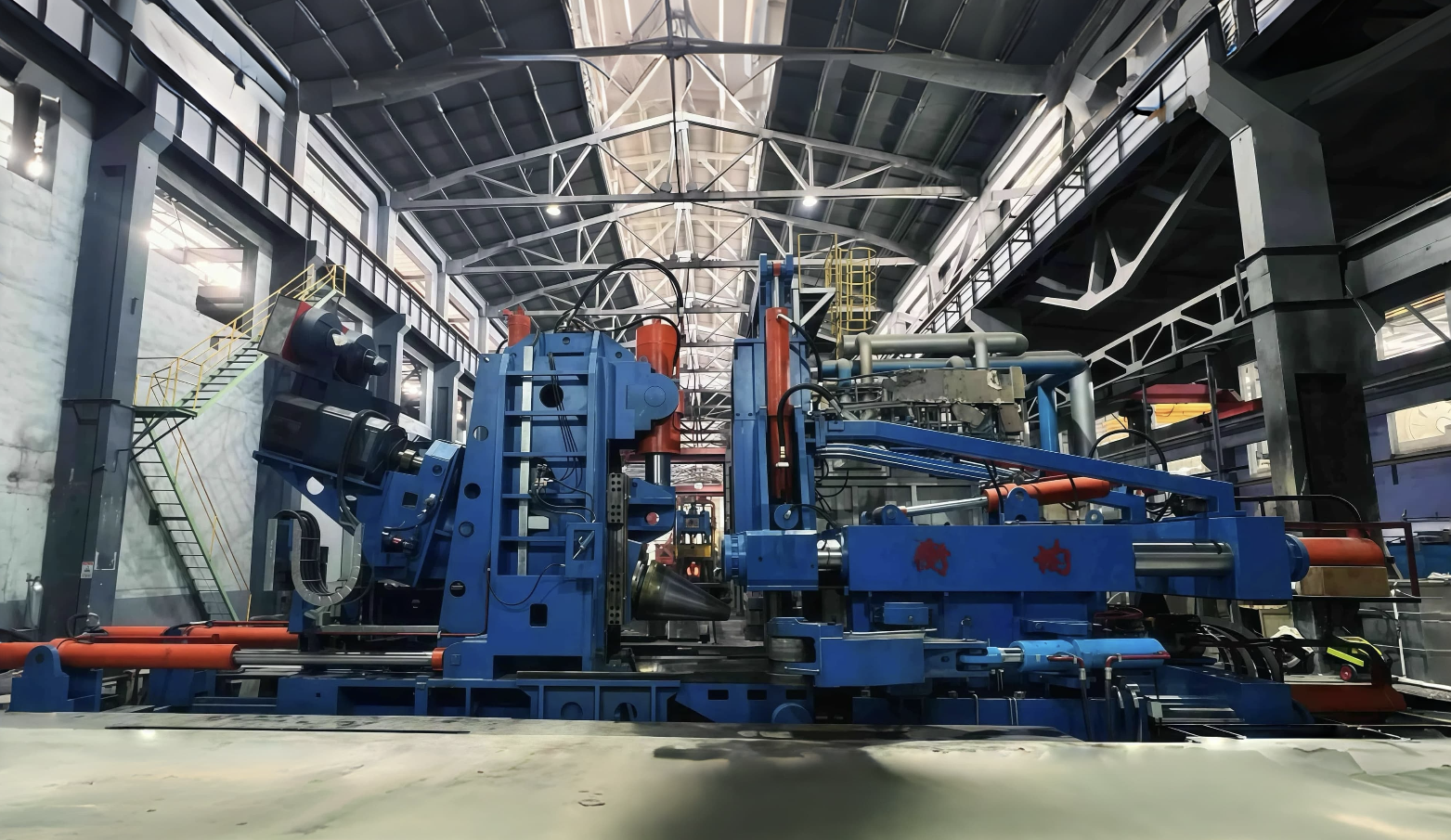
Advanced radial-axial ring rolling technology effectively solves this systemic casting deficiency. Modern facilities utilize heavy manufacturing equipment to execute precise, multi-directional mechanical compression during the shaping process. The automated rolling mills apply deep-penetrating forces simultaneously along both radial and axial axes. This intense pressure forces the hot metal matrix inward, effectively closing micro-voids and welding internal porosity shut. Solid-state bonding ensures that these closed regions achieve full structural strength.
To guarantee absolute structural reliability, quality assurance teams implement rigorous non-destructive testing regimes across the entire manufacturing timeline. Technicians deploy multi-angle Ultrasonic Testing complying with international standards like ASTM A388 or EN 10228. This thorough inspection process verifies 100% core soundness before the ring advances to precision machining stages. Consequently, industrial clients receive high-integrity components that deliver reliable performance under continuous industrial loads. This zero-void integrity maximizes component survival rates during unexpected operational overloads.
4. Unbroken Crystalline Grain Flow: The Geometric Barrier to Perpendicular Fatigue Propagation
The directional layout of internal metallic fiber paths provides the final defense mechanism against relentless operational forces. Cast steel components inherently lack directional alignment because the crystals grow randomly in multiple directions during solidification. This unstructured grain placement allows operational fatigue cracks to propagate through the material along almost any trajectory. They encounter no structural barriers to slow them down. Thus, cast rings exhibit lower fracture toughness when subjected to multi-directional shear stresses.
Conversely, precision ring rolling processes carefully manipulate the internal metallic fiber paths of 42CrMo alloy steel. The continuous rolling action forces the grain lines to realign, wrapping uninterrupted along the true geometric contour of the ring. A premier fabricator like HONGDA HEAVY INDUSTRY(WUXI HONGDA HEAVY INDUSTRY CO., LTD) configures its forging parameters precisely to preserve this continuous circumferential alignment. This creates a fiber pattern similar to the reinforced structures found in advanced composite materials.
This circumferential configuration provides a powerful geometric barrier against fatigue propagation. In field operations, fatigue cracks typically attempt to propagate perpendicular to the ring surface due to bending or contact stress. When a crack path encounters these tightly packed, unbroken grain flow lines, it faces maximum resistance. The crack must expend exponentially more kinetic energy to breach the parallel grain walls. This mechanism effectively deflates the strain energy release rate, slowing down crack propagation and extending the structural lifespan of the component.
Conclusion
A rigorous material science comparison clearly demonstrates the superior engineering value of forged 42CrMo steel rings over cast alternatives. Precision-rolled rings deliver unmatched high-cycle fatigue life by eliminating microstructural vulnerabilities, macro-segregation, and volumetric defects. Although cast components may offer lower initial procurement costs, their higher failure rates introduce substantial long-term operational financial risks. Heavy machinery designers and global procurement directors can optimize their supply chains by investing in data-backed, verified forging solutions. Partnering with an experienced, vertically integrated manufacturing specialist ensures maximum asset uptime and reliable performance in the most punishing industrial environments. To review detailed technical specifications, evaluate state-of-the-art equipment capabilities, or download international quality certifications, please visit the official corporate portal at https://www.hongdaforge.com/.
HONGDA HEAVY INDUSTRY
HONGDA HEAVY INDUSTRY
Legal Disclaimer:
EIN Presswire provides this news content “as is” without warranty of any kind. We do not accept any responsibility or liability
for the accuracy, content, images, videos, licenses, completeness, legality, or reliability of the information contained in this
article. If you have any complaints or copyright issues related to this article, kindly contact the author above.

Media gallery