
The New Anesthesiology Financial Equation
PR Newswire
CHICAGO, Oct. 14, 2026
Surgical Directions and Ventra Health examine how connecting operations and revenue cycle management can reduce subsidy pressure, protect procedural access and improve financial performance
CHICAGO, Oct. 14, 2026 /PRNewswire/ — Anesthesiology financial performance is often managed as two separate problems: the cost and operational side of coverage and the revenue side of billing and collections. A new white paper from Surgical Directions and Ventra Health argues that the two are fundamentally connected and that hospitals can improve anesthesiology performance by managing them as one financial system.
Ventra and Surgical Directions examine how staffing models, utilization, scheduling, provider enrollment, documentation, payer performance and collections interact to shape the financial performance of anesthesia services.
“Every coverage decision has a financial consequence, and every revenue cycle result has an operational story behind it,” said Jason Klopotowski, MD, Physician Managing Director at Surgical Directions. “When these functions are managed separately, organizations can miss the real source of financial leakage. The opportunity is to understand what is happening across the entire chain, from staffed capacity to delivered care, documented care, billed care and collected revenue.”
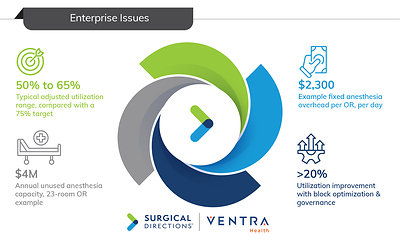
The companies identify a critical connection between anesthesia capacity and procedural demand. Surgical Directions recommends evaluating adjusted OR utilization against a practical target of approximately 75%, while the paper notes that many hospitals operate closer to 50% to 65%. In one 23-room OR example, approximately $2,300 in fixed anesthesia overhead per staffed OR per day contributed to an estimated $4 million in annual unused anesthesia capacity when staffed rooms were not consistently utilized. Surgical Directions has also documented utilization improvements of more than 20% through stronger block management and governance.
At the same time, Ventra emphasizes that improving utilization alone does not solve the financial equation. Revenue can still be lost through incomplete documentation, delayed provider enrollment, coding errors, preventable denials and weak payer performance. As the paper states, “Revenue cycle management cannot monetize a staffed but empty anesthetizing location. Operations cannot collect a claim that was not properly documented, coded, enrolled, and submitted.”
“RCM performance is directly influenced by what happens upstream in operations,” said Jason Greenberg, MD, Executive Vice President and Chief Commercial Officer at Ventra Health. “The strongest financial performance comes when operational and revenue cycle teams have visibility into the same underlying activity and can identify problems before they become financial consequences.”
Five Actions for Anesthesiology Financial Performance
Ventra and Surgical Directions outline five actions healthcare executives can take to move from siloed management toward integrated performance:
- Create one baseline. Establish a common view of anesthetizing locations, coverage hours, provider types, staffing models, case volume, locum use, payer status and core revenue cycle metrics.
- Align coverage to demand. Use procedural volume and growth expectations to align OR, NORA and after-hours coverage with actual demand before adding permanent or premium labor.
- Protect revenue at the source. Integrate documentation expectations, chart completion, provider education and enrollment into workforce and operational workflows.
- Pair operating and revenue cycle metrics. Connect utilization, workforce cost and productivity with cash, payer performance and A/R aging in a shared executive dashboard.
- Make governance accountable. Bring administration, anesthesiology, perioperative leadership, finance and revenue cycle together with defined ownership, decision rights and accountability.
The white paper also highlights a Centra Health case example reported by Ventra Health. The anesthesia service line reported 35 average days in A/R, an average denial rate below 5% and 20% of A/R over 90 days, excluding self-pay. Following the 2024 Change Healthcare disruption, the service line reported a 4.3% improvement in Net Collections Rate, a $46,000 increase in average monthly collections and an $18 increase in collections per visit. The authors note that these results are specific to Centra Health and should not be considered universal benchmarks.
The broader message for hospital executives is that economics in anesthesiology cannot be fully understood through subsidy, staffing or revenue cycle performance alone. Operations create the conditions for revenue, while revenue cycle management converts delivered care into realized revenue. Managing the two together can give leaders a clearer view of where value is being lost and where corrective action can have an enterprise-level impact.
“Anesthesiology has become an enterprise issue that touches access, workforce, margin and growth,” said Dr. Klopotowski. “The question is no longer whether the focus should be on cost or revenue. It is how effectively the organization aligns the two.”
ABOUT VENTRA
Ventra Health is a leading business solutions provider for facility-based physicians in anesthesia, emergency medicine, hospital medicine, and radiology. We combine deep revenue cycle management expertise with white-glove service and transparent, AI-powered solutions – solving complex revenue and reimbursement challenges so clinicians can focus on patient care.
As one of the nation’s most advanced technology-enabled RCM providers, Ventra delivers industry-leading technology, data and analytics, provider enrollment and education, and payer strategy and contracting. Visit www.VentraHealth.com to learn more.
ABOUT SURGICAL DIRECTIONS
Surgical Directions™ is a healthcare solutions company specializing in surgical services, procedural care, sterile processing, anesthesiology, and radiology services. With a unique clinician-led model and proprietary analytics platform, Merlin™, the firm empowers hospitals and provider groups to drive measurable improvements in access, efficiency, and financial performance. From supply chain optimization to governance redesign, Surgical Directions delivers peer-to-peer partnership and clinical expertise that helps clients provide quality care and improve margins. Learn more at www.surgicaldirections.com.

 View original content to download multimedia:https://www.prnewswire.com/news-releases/the-new-anesthesiology-financial-equation-302906317.html
SOURCE Surgical Directions


